
Employee Wellness Benefits Utilization: Closing the Gap
Employers are spending more on wellness than ever before. The average employer offers 20+ different well-being programs. And yet, less than 20% of employees report actually using the wellness programs available to them. At the same time, expectations are rising: nearly all employers (94%) say they want their well-being vendors to deliver better outcomes: more engagement, fewer claims, lower costs.
For wellness brokers, this engagement gap isn’t a challenge. It’s an opening. You’re uniquely positioned to identify high-performing partners, align solutions with workforce needs, and bring data-driven recommendations to the table.
So where is engagement breaking down, and how can you help your clients close the gap?
The Real Reasons Employees Aren't Using Wellness Benefits
Poor utilization is often written off as employee apathy. However, the data tells a different story, one of poor communication, little awareness, and a lack of clarity.
1. Employees Don't Know What They Have
Lack of awareness is one of the most common (and most preventable) drivers of low utilization. Communicating benefits with an email during open enrollment is not enough. Benefits that aren’t communicated at the right moment, in the right format, and repeatedly throughout the year don’t get used.
2. The Experience Is Too Complicated
About 68% of workers do not use the full value of their well-being resources because accessing them is too time-consuming or confusing. When employees have to remember separate logins or fill out lengthy forms to access a wellness benefit, most won’t bother. Unfortunately, this impacts those who usually need the support most.
3. They Don't See the Value
If employees don’t understand what a program does or assume there’s an out-of-pocket cost to participate, they disengage. This is why consistent education and communication are so important. Benefits leaders shouldn’t only be listing off the programs available, but bringing them to life by explaining what they do, why they matter, and how employees can use.
4. The Programs Don't Fit Real Life
Programs that require in-person wellness activities or clinical appointments limited to standard business hours create unnecessary friction for employees. As McKinsey highlights, many wellness programs underperform not because they lack value, but because they’re built for conformity instead of context.
5. Poor Trust
According to Gallup, 79% of employees don’t feel their company truly cares about their well-being, even at companies actively spending on wellness benefits. When employees think that wellness investments are performative, it creates cynicism that extends to even well-designed programs.
What's at Stake: By the Numbers
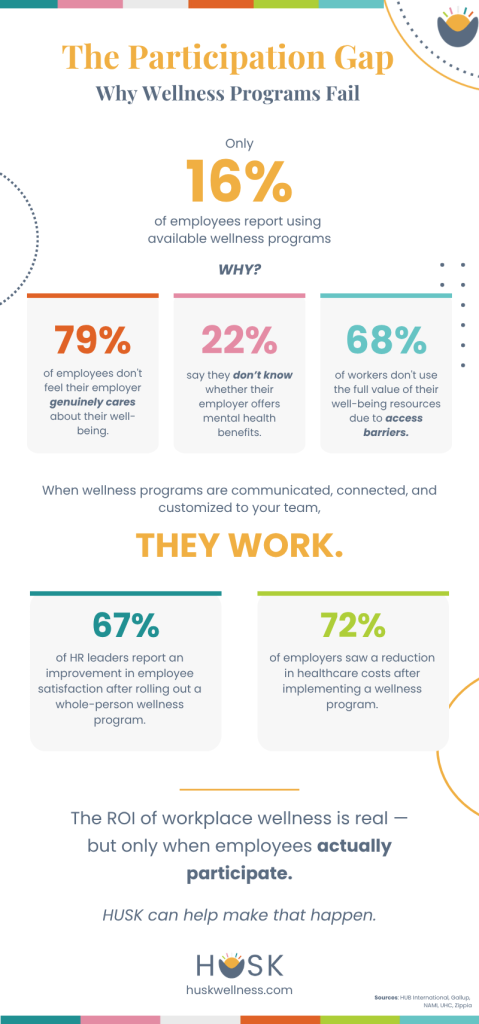
- 16% of employees report using available wellness programs (HUB International, 2025)
- 79% of employees don’t feel their employer genuinely cares about their well-being (Gallup, 2024)
- 22% of managers say they don’t know whether their employer offers mental health benefits, even as stress and burnout reach record highs (NAMI, 2025)
- 68% of workers don’t use the full value of their well-being resources due to access barriers (UHC, 2024)
- 67% improvement in employee satisfaction, 17% boost in retention, and a 6% increase in productivity—whole-person health programs have proven to deliver measurable results. (UHC, 2026)
- 72% of employers saw a reduction in healthcare costs after implementing a wellness program (Zippia, 2023)
The ROI of workplace wellness is real, but only when employees actually participate.
4 Strategies to Drive Benefits Utilization
1. Identify & Close Communication Gaps
Work with your clients to build a benefits communication calendar of monthly touchpoints, seasonal campaigns, manager-level talking points, and reminders aligned to life moments (e.g., stress awareness month, open enrollment windows, Q4 burnout season).
2. Recommend Programs That Have Engagement Built In
Not all wellness platforms are built equally from a participation standpoint. However, the most effective programs share a few common traits:
- Social and team-based challenges that create accountability and community.
- Reward and recognition features that reinforce ongoing behavior vs. one-time actions.
- Visible progress tracking so employees feel momentum.
Platforms like HUSK Challenge and Rewards are built around the idea of ongoing engagement. They’re gamified and designed to meet employees where they are, whether that’s tracking steps, completing a nutrition goal, or engaging with a mental health resource. The engagement features are part of the product, not an afterthought.
3. Align Wellness Benefits to Metrics
Proactively measure performance against company goals, employee needs, and cost-containment strategies, rather than waiting until renewal time to review. Connect the dots for your clients between utilization and the numbers they care about: claims trends, absenteeism, employee turnover, and premium trajectory.
4. Simplify the Portfolio
Help your clients audit their wellness stack and consolidate where possible with one vendor who can offer admin, support, and guidance. As a bonus: a single vendor often has the reporting and resources to truly know employees, their needs, and their interests, so you and your client can cater a wellness experience meant for them.
Turn Insight Into Action
Employees aren’t skipping wellness benefits because they don’t care about their health. They’re skipping them because the experience is too hard, too confusing, or too disconnected from their day-to-day lives. But for wellness brokers, these gaps are opportunities. Brokers who can bridge them with data, strategy, and the right vendors will build relationships that last.
If you’re looking for a wellness platform built around engagement, explore HUSK’s wellness solutions and see how built-in engagement can change the utilization conversation.
Frequently Asked Questions
Why is wellness benefits utilization so low?
Several barriers limit wellness benefits utilization: lack of awareness, complicated or time-consuming access, perceived cost, programs that don’t fit employees’ schedules or lifestyles, and a general trust gap between employees and employers.
What is a good wellness program participation rate?
Effective wellness programs with built-in engagement tools and incentives can achieve participation rates of 40–60% or higher. Passive programs without engagement features often fall below 20%.
How can benefits brokers help improve wellness utilization?
Benefits brokers can drive utilization by identifying communication gaps, recommending vendors with engagement-first design, and connecting wellness performance to relevant metrics like claims trends and absenteeism.
What types of wellness programs have the best participation rates?
Programs that combine social or team-based challenges, gamified rewards, low-friction access, and mobile-first design outperform passive programs.
What should employers look for in a wellness platform to improve utilization?
Employers should look for wellness platforms that have engagement features built into the product. This includes participation challenges, a rewards system, easy onboarding, and mobile accessibility.