
Turning Rising Healthcare Costs Into Wellness ROI
Healthcare costs are climbing at the fastest pace in more than a decade. For your clients, that means hard budget conversations this renewal season. But for you, this could mean a chance to bring something more valuable to the table: a strategy for improving wellness ROI while helping clients manage rising healthcare costs.
What's Actually Driving Rising Healthcare Costs?
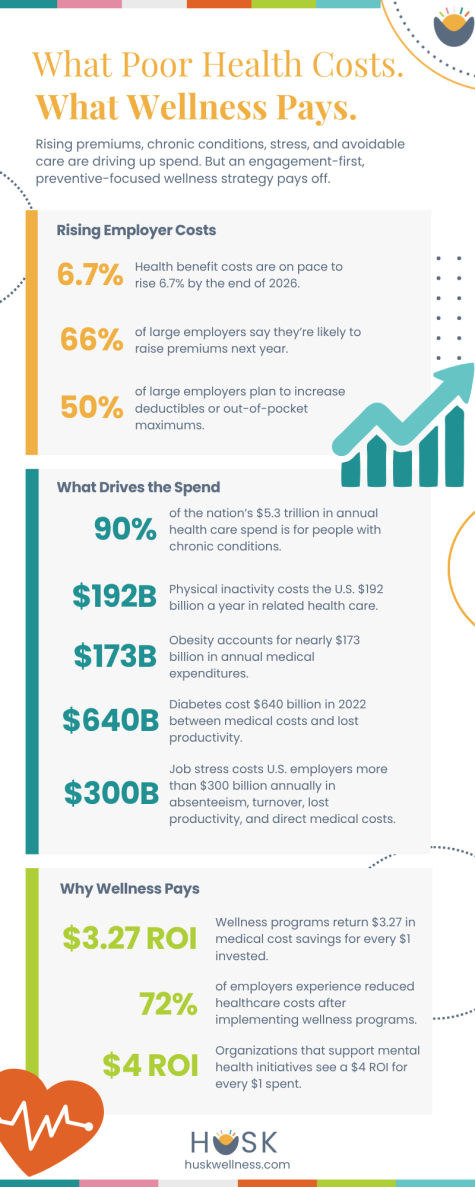
A new report shows health benefit costs are on pace to rise 6.7% by the end of this year, pushing average per-employee costs above $18,500. Most employers’ first move? Cost-shifting. Sixty-six percent of large employers say they’re likely to raise premiums next year, and roughly half plan to increase deductibles or out-of-pocket maximums.
You’re likely no stranger to discussions around cost-cutting. While the strategy does buy your clients a bit of breathing room in the short term, it doesn’t alleviate some of the main drivers of rising costs: underutilized benefits and delayed care that turns manageable health issues into chronic conditions and expensive claims.
This is where you can differentiate.
What's the Alternative to Cutting Coverage?
What if, instead of talking to clients about rate shopping and cost cutting, you showed them how much they could save by shifting the conversation from cutting costs to preventing claims?
About 90% of the nation’s $5.3 trillion in annual health care spend is for people with chronic and mental health conditions.
- Physical inactivity costs the U.S. $192 billion a year in related health care (CDC)
- Obesity accounts for nearly $173 billion in annual medical expenditures (CDC)
- Diabetes cost $640 billion in 2022 between medical costs and lost productivity (CDC)
- Job stress costs U.S. employers more than $300 billion annually in absenteeism, turnover, lost productivity, and direct medical costs (American Institute of Stress)
These costs are often the result of reactive care. Employers end up spending the most when employees receive treatment only after a condition has progressed, whether that’s diabetes, musculoskeletal issues, obesity-related complications, or stress-related health concerns. By the time a claim becomes expensive, the opportunity for lower-cost intervention has often already passed.
Instead, a focus on preventive care can help employers slow claims growth over time. When employees have easier access to nutrition support, fitness programs, health coaching, mental health resources, and screening opportunities, they’re more likely to address risks before they become chronic conditions. This is why employers that invest in prevention often see measurable returns in both healthcare spending and workforce productivity, improving overall wellness ROI while reducing future claims risk.
- Wellness programs return $3.27 in medical cost savings and $2.73 in reduced absenteeism costs for every $1 invested, per a landmark Harvard meta-analysis of 36 studies published in Health Affairs
- 72% of employers experience reduced healthcare costs after implementing employee wellness programs. (Zippia)
- Organizations that support mental health initiatives see a $4 ROI for every $1 spent. (NORC.org)
How Can Brokers Help Clients Get More From Their Benefits Spend?
Once you’ve highlighted the cost of chronic conditions and the value of preventive care, the next step is helping your clients increase engagement with the benefits they’re already paying for.
The employers seeing the strongest wellness ROI aren’t always adding new programs. More often, they’re creating engagement experiences around existing benefits that encourage employees to take action before health issues become costly claims.
These can include:
- Connecting employees with nutrition counseling and lifestyle support that may already be covered by their health plan
- Offering incentives for preventive screenings, annual physicals, or gym attendance
- Running walking, fitness, or wellness challenges that create friendly competition and social accountability
- Using rewards, streaks, and milestone-based recognition to reinforce healthy habits over time
- Simplifying access through mobile tools that make participation easy and visible
Before the next renewal, ask clients:
- What’s our current utilization rate by benefit or program?
- Which preventive care benefits are already covered but underused?
- How are benefits being promoted outside of open enrollment?
- What incentives exist to encourage ongoing participation?
- How many steps does it take for an employee to actually use a benefit?
(For a deeper look at why engagement breaks down and how to fix it, see why employees don’t use their wellness benefits (and what brokers can do about it).)
For context on what’s possible: employers using engagement-focused wellness solutions through HUSK have hit engagement rates as high as 63%, more than three times the industry average. Higher engagement means more preventive care, earlier interventions, and more chances to catch a problem before it becomes a high-cost claim.
What Should Brokers Do This Benefits Renewal Season?
Rising costs aren’t going away, and neither is the instinct to raise premiums or cut coverage in response. But you have an opportunity to reframe the conversation. Instead of asking how to absorb another year of rising costs, ask: How can we help more employees engage in preventive care before those costs become claims?
Want to bring stronger wellness ROI data and engagement strategies to your next client conversation? Talk to HUSK about broker partnership resources.
Frequently Asked Questions
What is a typical wellness benefits ROI?
Employers often evaluate wellness ROI through reductions in healthcare spending, absenteeism, and productivity losses. Wellness programs return $3.27 in medical cost savings and $2.73 in reduced absenteeism costs for every $1 invested, per a landmark Harvard meta-analysis of 36 studies published in Health Affairs.
Why isn't cost-shifting an effective long-term strategy for lowering corporate healthcare costs?
Raising premiums or deductibles reduces employer cost in the short term, but it doesn’t address the underlying causes of rising healthcare spend: underutilized benefits and delayed care. In fact, it exacerbates these trends. More expensive care means employees go longer without preventive intervention.
What should brokers ask clients about their current wellness vendor?
Brokers should ask what their client’s actual benefit utilization and engagement rates are. Industry-average engagement sits under 20%, while engagement-focused wellness programs can reach rates as high as 60+%, a gap that directly affects how much preventive care employees receive and how many claims employers avoid.
×